

Welcome
Do you want to make a difference to those in need in your community and to the environment?
The IT Reuse for Good Charter encourages organisations across the UK to take a ‘reuse first’ approach to IT assets such as laptops and smartphones — refurbishing and donating end-of-life devices to people who are digitally excluded. The charter was developed by the former Department for Science, Innovation and Technology (DSIT), Good Things Foundation, VodafoneThree and Deloitte LLP, It sets a new standard for responsible, sustainable IT asset management in the UK, adding to — rather than replacing — existing asset disposal processes. The charter is a commitment in the Digital Inclusion Action Plan, published in February 2025.
This playbook will help you think about how your business or organisation can implement an IT reuse programme that promotes both circularity and digital inclusion.
About the IT Re-use for Good Charter

Beginning a reuse programme is not always a process with a clear beginning, middle and end, and will work differently for different organisations. You don’t necessarily need to read the playbook from start to finish but can dip into the different sections that will be most useful to your organisation. You might want to start by thinking about the distribution phase and who will be the recipients of your devices. You might want to start by thinking about what partnerships you would need to be able to take on refurbishment. Or you might simply be looking at a cupboard full of old laptops and wondering what you can do with them. Whether you’re getting started or ready to scale an existing scheme, this playbook is intended to be a companion to the questions that you have about different aspects of re-using IT for good.
Impact
IT Re-use for Good: An overview
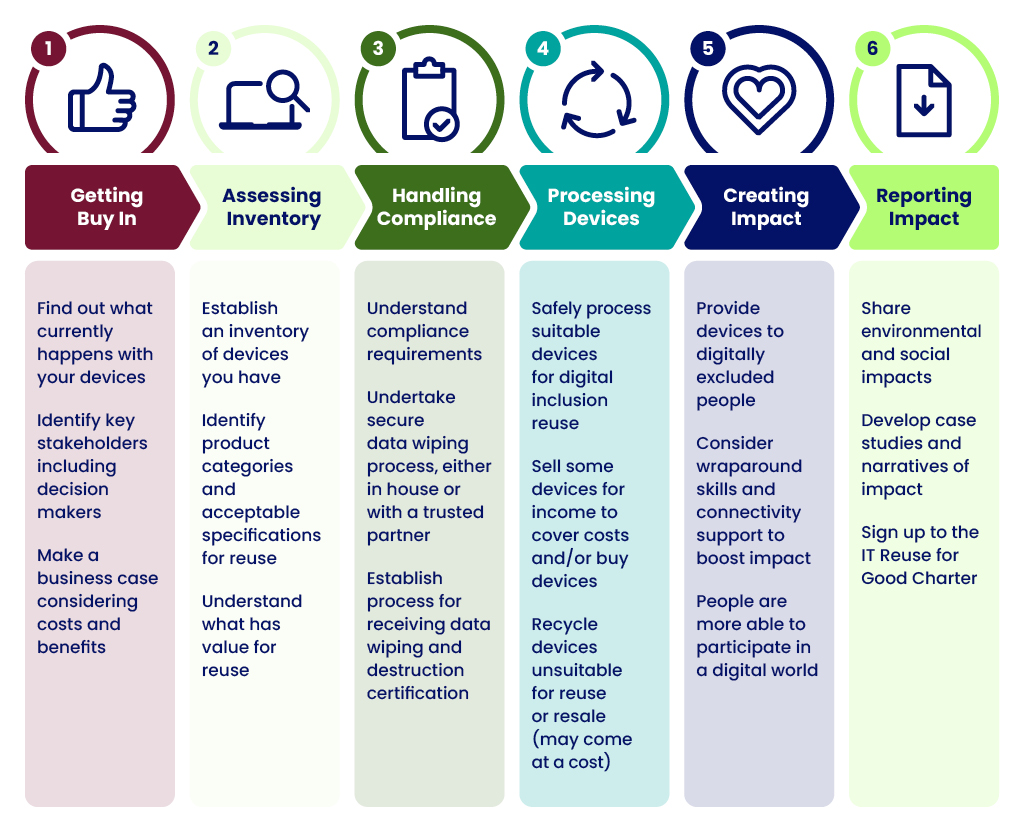
1. Getting Buy In
- Find out what currently happens with your devices
- Identify key stakeholders including decision makers
- Make a business case considering costs and benefits
2. Assessing Inventory
- Establish an inventory of devices you have
- Identify product categories and acceptable specifications for reuse
- Understand what has value for reuse
3. Handling Compliance
- Understand compliance requirements
- Undertake secure data wiping process, either in house or with a trusted partner
- Establish process for receiving data wiping and destruction certification
4. Processing Devices
- Safely process suitable devices for digital inclusion
- Sell some devices for income to cover costs and/or buy devices
- Recycle devices unsuitable for reuse or resale (may come at a cost)
5. Creating Impact
- Provide devices to digitally excluded people
- Consider wraparound skills and connectivity support to boost impact
- People are more able to participate in a digital world
6. Reporting Impact
- Share environmental and social impacts
- Develop case studies and narratives of impact
- Sign up to the IT Reuse for Good Charter
This overview is intended to share the critical process components, whilst we have shown it as a step by step process it is important to note that you might start at different points in the process, for example signing the IT Re-use for Good Charter could be the trigger to getting buy in rather than the end game!
Pioneering organisations
Organisations from the private and public sector all around the UK are already re-using IT for social good and throughout this Playbook we will share case studies to spotlight their work
Case study
Making a difference: Metropolitan Police Service
16 tonnes of e-waste prevented, and families in digital poverty supported

Case study
Making a difference: Metropolitan Police
The Metropolitan Police Service donated 17,000 used ICT devices to Good Things Foundation to be re-homed. This avoided 16 tonnes of waste and helped families experiencing digital poverty.
Source: GLA Group Responsible Procurement Progress Report 2023 

Case study
Giving devices a new lease of life: VodafoneThree
Vodafone UK set up the Great British Tech Appeal

Case study
Giving devices a new lease of life: VodafoneThree
"We set up the Great British Tech Appeal to allow consumers and businesses to donate old devices and give them a new lease of life, doing good for both people and the planet. This programme supports a circular economy and helps people in need cross the digital divide. We work with our partners to make sure that every reusable device goes towards someone in need, along with six months free data, calls and texts."

Getting started
Are you at the start of your journey? You should:
- Collaborate with accredited and established partners who can provide expertise, connections and reassurance over data security and legal compliance.
- Make sure your scheme complies with legislation and regulations on data security and e-waste
- Decide on your key drivers and bring together the right people to support your work – from department level (senior leadership, IT, asset management, sustainability) to individual champions with the passion to drive your scheme forward
- Start small – whatever assets are currently available can be donated for a quick win and positive reporting (ESG and Social impact)
- Make sure you know what kit is reusable, what can be recycled and what will need to be responsibly disposed of
- Decide who will be the recipients of your refurbished devices, how you will make sure devices go to those who are digitally excluded, and how you will make sure devices distributed are of a suitably high standard
- Find a cost-effective pathway that works for your organisation
- Decide what wraparound support you will offer
Ready to scale up an existing scheme?
- Build on short-term partnerships for longer-term impact and cost efficiency
- Seek out partners who can help to expand your reporting and increase knowledge sharing opportunities, e.g., to quantify your social and/or environmental impact values
- Take advantage of catalysts such as refresh cycles and existing partnerships to grow your scheme
- Embed IT reuse into your processes and procedures so it becomes Business As Usual
- Build your scheme into your annual reporting on both sustainability and social impact
- Seek out funding sources and cost savings to increase the sustainability of your scheme
- Expand your wraparound support offer, your distribution pathway, and/or contribution amounts